Showing posts with label BCA-3rd Sem. Show all posts
Thursday, November 15, 2018
ALL BCA 3rd Semester Monthly Test Question paper of Punjabi University Patiala
C++ BCA 3rd Semester Monthly Test Question paper of Punjabi University Patiala ,Baba Jogi peer Neighborhood campus ,RALLA
------------------------------------
DBMS, BCA 3rd Semester Monthly Test Question paper of Punjabi University Patiala ,Baba Jogi peer Neighborhood campus ,RALLA
DESC.MATHEMATICS BCA 3rd Semester Monthly Test Question paper of Punjabi University Patiala ,Baba Jogi peer Neighborhood campus ,RALLA
Tuesday, November 6, 2018
Question Paper 2017 of BCA 2nd Year of Punjab University Question paper

Punjabi University Question Paper
Course: BCA
OBJECT ORIENTED PROGRAMMING (USING C++)
Time allowed: 3 Hours
Max. Marks: 90
Study Materials Description : 2017 Punjabi University B.C.A Computer Application Object Oriented Programming (Using C++) Question Paper 2017 of BCA 2nd Year of Punjab University Question paper
ATTEMPT FIVE QUESTIONS IN ALL, SELECTING TWO QUESTIONS EACH FROM SECTION - A AND SECTION – B SECTION C IS COMPULSORY.
SECTION - A
1. Differentiate between
(a) Procedural Analysis and Object oriented analysis.
(b) Data encapsulation and Data Inheritance. (9,9)
2.(a) What are pre-processor directives? Explain their use with the help of an example.
(b) Explain the structure of an object oriented C++ program.
(c) Explain the use of function main(). (7,7,4)
3. (a) Define a class "ACCOUNT". Include following members:
Data Members: Name of Depositor, Account No., Type of Account, Balance Amount.
Member Function: To assign initial values, deposit amount, with draw after checking balance, To display name and balance. Write main Program to test the program for 10 customers.
(b) What are array of objects ? Explain with example with detail. (12,6)
4.(a) Differentiate between Pass By Value and Pass By Reference.
(b) What are different types of function declarations? How will you declare a function outside the class?
(c) Explain copy constructor with the help of an example. (6, 6, 6)
SECTION – B
5. (a) What is function overloading? Write a program in c++ which has a Function add that is able to concatenate two strings, if values passed Are strings and can perform addition, if values are numbers.
(b) Explain inline functions and also create one. (12, 6)
6. (a) What are abstract classes? Explain their use.
(b) How can protected members of a class become inheritable?
(c) Explain the concept of nested classes. (6, 6, 6)
7. Differentiate between
(a) Private & Public Inheritance
(b) Stacks and Queues
(c) Multiple and multilevel inheritance
8. (a)What is linked list? What are its advantages and disadvantages ?
(b) Write a program to create a linked list and perform-
(i) Insertion – at the beginning, at the end and in between
(ii) Deletion – at given position
(iii)Display elements.
SECTION – C
9. (a) What is data hiding?
(b) Explain input and output streams.
(c) Explain scope resolution operator.
(d) What are destructors? Give example.
(e) What is operator overloading?
(f) Differentiate between single and multiple inheritances.
(g) What are base and derived classes?
(h) What are various methods to traverse a tree?
(i) Explain the concept of a class. (9*2=18)
Monday, November 5, 2018
what are Constant Arguments in Cpp by 124Study.blogspot.in
Advantages and Disadvantages Of Object Oriented Programming C++ By 124 Study App
- OOP provides a clear modular structure for programs.
- It is good for defining abstract data types.
- Implementation details are hidden from other modules and other modules has a clearly defined interface.
- It is easy to maintain and modify existing code as new objects can be created with small differences to existing ones.
- objects, methods, instance, message passing, inheritance are some important properties provided by these particular languages
- encapsulation, polymorphism, abstraction are also counts in these fundamentals of programming language.
- It implements real life scenario.
- In OOP, programmer not only defines data types but also deals with operations applied for data structures.
- Size: Object Oriented programs are much larger than other programs. In the early days of computing, space on hard drives, floppy drives and in memory was at a premium. Today we do not have these restrictions.
- Effort: Object Oriented programs require a lot of work to create. Specifically, a great deal of planning goes into an object oriented program well before a single piece of code is ever written. Initially, this early effort was felt by many to be a waste of time. In addition, because the programs were larger (see above) coders spent more time actually writing the program.
- Speed: Object Oriented programs are slower than other programs, partially because of their size. Other aspects of Object Oriented Programs also demand more system resources, thus slowing the program down.
Sunday, November 4, 2018
What are variables? List C++ rules for variables naming.
Difference Between Static and Dynamic Binding in c++ by 124study.blogspot.in
Content: Static Vs Dynamic Binding
Comparison chart:
| BASIS FOR COMPARISON | STATIC BINDING | DYNAMIC BINDING |
|---|---|---|
| Event Occurrence | Events occur at compile time are "Static Binding". | Events occur at run time are "Dynamic Binding". |
| Information | All information needed to call a function is known at compile time. | All information need to call a function come to know at run time. |
| Advantage | Efficiency. | Flexibility. |
| Time | Fast execution. | Slow execution. |
| Alternate name | Early Binding. | Late Binding. |
| Example | overloaded function call, overloaded operators. | Virtual function in C++, overridden methods in java. |
What is inheritance? What are the base and derived classes? Give a suitable example of inheritance. by 124study.blogspot.in
C++ Multiple, Multilevel and Hierarchical Inheritance. ... Inheritance is one of the core feature of an object-oriented programming language. It allows software developers to derive a new class from the existing class. The derived class inheritsthe features of the base class (existing class).
What are the base and derived classes?
A base class is a class, in an object-oriented programming language, from which other classes are derived. It facilitates the creation of other classes that can reuse the code implicitly inherited from the base class (except constructors and destructors). A programmer can extend base class functionality by adding or overriding members relevant to the derived class.
derived Classes ???
Any class type (whether declared with class-key
class or struct) may be declared as derived from one or more base classes which, in turn, may be derived from their own base classes, forming an inheritance hierarchy.What are the elements of object oriented Programming? 124study.blogspot.in
List down elements of an object oriented language.
Class :A class is a user defined data type. It serves as a template of the objects. You can define structure and behavior of an object using class. It includes data and the member functions that operate on data.
Inheritance :
Inheritance enables a new class to reuse the state and behavior of old class. The new class inherits properties and methods from the old class and is called as derived class and the old class is called as base class. The methods thus inherited can be extended using overriding facility of C++.
Encapsulation :
The wrapping up of data and member function into an object is called encapsulation. The data is not accessible to the outside world and only those functions which are wrapped into the object can access it. An encapsulated objects act as a "black box" for other parts of the program which interact with it. They provide a service, but the calling objects do not need to know the details how the service is accomplished.
Polymorphism :
Polymorphism enables one common interface for many implementations, and for objects to act differently under different circumstances. You can also achieve polymorphism in C++ by function overloading, operator overloading and implementation inheritance.
Saturday, November 3, 2018
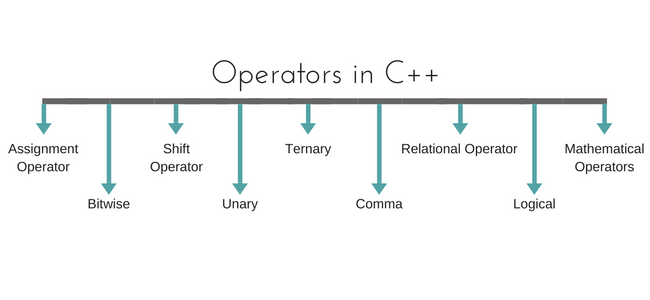
Operators in C++ by 124study.blogspot.in
Types of operators
- Assignment Operator
- Mathematical Operators
- Relational Operators
- Logical Operators
- Bitwise Operators
- Shift Operators
- Unary Operators
- Ternary Operator
- Comma Operator
Assignment Operator ( = )
Mathematical Operators
int x=10; x += 4 // will add 4 to 10, and hence assign 14 to X. x -= 5 // will subtract 5 from 10 and assign 5 to x.
Relational Operators
int x = 10; //assignment operator x=5; // again assignment operator if(x == 5) // here we have used equivalent relational operator, for comparison { cout <<"Successfully compared"; }
Logical Operators
Bitwise Operators
- Bitwise AND operators
& - Bitwise OR operator
| - And bitwise XOR operator
^ - And, bitwise NOT operator
~
Shift Operators
Unary Operators
Ternary Operator
int a = 10; a > 5 ? cout << "true" : cout << "false"
Comma Operator
int a,b,c; // variables declaration using comma operatora=b++, c++; // a = c++ will be done.